Label History / The Fields
From 10 Handmade CDs to Dolby Atmos
The ten CDs are gone. The music is everywhere.
In 2002 I made ten CDs by hand.
Burned them one at a time. Printed the covers myself. Packaged them up and sold every single one. I don't know where any of them are now. I've never found a single copy. For all I know they're in a landfill somewhere in Nebraska, sitting in somebody's storage unit that hasn't been opened since the Bush administration, or they disintegrated the first time a car got too hot in July.
In 2023, Sugar Cones released their debut album Swinging in Dolby Atmos on Apple Music.
Those two facts exist in the same timeline. Same label. Same person behind the board. Twenty-one years apart.
2002: Style X
Style X was five tracks. Bass-heavy beats with a little rapping over them, made entirely out of sounds I downloaded off the internet through IRC - which, if you weren't alive for it, was the wild west of file sharing before file sharing had a face. Finding the right sound could take hours. Downloading it on 256 kbps cable internet, which felt like goddamn science fiction compared to the dial-up I'd had in North Platte the year before, took even longer. I was hunting sounds one file at a time and waiting forever for each one to finish like it personally owed me something.
I sat in front of a hacked copy of Cakewalk and built five tracks out of whatever I could find. The mixing was whatever I knew how to do at the time, which frankly wasn't shit. The production was scrappy and raw in ways that weren't always intentional.
But I made it. Packaged it. Put it in my car.
Now - I said I sold all ten copies, but that's not quite the full story. Maybe four of them went to people I actually knew. The rest went to strangers, because I was twenty years old and too damn proud of something to keep it to myself.
I specifically remember sitting in the parking lot of the Time Saver on the one-way in North Platte. I was in my 1996 Ford Probe GT - two twelve-inch subs in the back, because of course I was - playing my own shit loud enough that when I pulled into that gas station, some guy outside heard the bass thumping and walked over to ask what I was listening to. I told him it was me. Sold him a CD right there in the parking lot. I don't know that man's name. I don't know if he ever listened to it. But he's got a piece of KFR history whether he knows it or not.
That's where this starts. Not in a studio. Not with a deal. Not with any of the shit people assume you need before you're allowed to call yourself a label. It starts with somebody at midnight hunting down sounds one painful file at a time, pressing play in a gas station parking lot, and selling a CD out of their car to a complete stranger because the bass was loud enough to get his attention.
The scale changes. The tools change. The quality - hopefully - changes. But the job is always the same: make the thing, get it to the people who need to hear it. By whatever means necessary.
The Biggest Mistake I Made
What happened between 2002 and when this started looking like a real operation isn't a straight line. It's a decade-plus of learning in real time, getting better at the craft in ways that don't show up on a resume, and building something that existed mostly in the stubbornness of two brothers who flat out refused to quit.
I've made a lot of mistakes in that stretch. But if I'm being honest about the biggest one, it's this: I didn't take Anthony seriously soon enough.
He told me about the writings in 2016. He was already working through what would become the Book of Colors trilogy - the depression, the characters, the arc he had fully mapped out in his head - and he brought it to me and I brushed it off. Not because I thought it was bad. I just wasn't paying attention the way I should have been. I didn't understand what the hell he was actually building.
It wasn't until 2018, when he put the demo for "End" in front of me, that I finally heard it. And by then he'd been sitting on this thing for two years.
We lost time we didn't need to lose. We could have been further along, further into building the infrastructure to release it properly, if I had just listened better in 2016. That's on me. I carry that. And it's the reason I don't half-listen to anyone in this building anymore when they tell me they're working on something. Because you don't always get to know in the moment when someone is handing you the most important thing they'll ever make.
Studio A: A Closet, a Basement, and a Kid Eating Spaghetti
When I started taking engineering seriously - really seriously, not just doing it but deciding to master it - the studio was my apartment in Bishop Heights.
Vocal booth: the master bedroom walk-in closet. Long XLR cable running from the living room, where the MacBook Pro and the desk lived, all the way to the closet. Boom arm hung inside. Blankets on the walls. That was the whole damn setup.
The studio wasn't open to the public. Unless I knew you personally, you weren't getting in. So the vibe was less "professional recording studio" and more: Anthony tracking in the closet while Keanu sat at the kitchen table fifteen feet away eating spaghetti. That was a real and recurring thing that happened regularly. That was The Fields before The Fields existed.
The Book of Colors is the spine of everything this label has ever built. Black, Sanguine, and Gold are the foundation - every record that comes out of KFR gets measured against what Anthony did across those three albums, and it's not a close comparison. Black was recorded entirely in that closet. By Sanguine and Gold, we'd added a second location - our homie Mike Morton's basement, which I'll get back to in a minute.
The recordings held up. The mixes held up. None of it needed a $50,000 vocal booth. It needed a mic, a preamp, ears that knew what the fuck they were doing, and an artist who'd run forty-five takes until the performance was exactly right.
That's still true. The room matters a hell of a lot less than people think.
In terms of pure fun - the sessions with the best energy coming out of that era - it was Ghost Stories. theyAreGhost flew in from California, we filmed the whole recording process as a documentary, and me and Anthony had an absolute blast doing it. Watching somebody come all the way from California and immediately get it, immediately understand what we were building out here in Nebraska - that energy was infectious as hell. That was the apartment studio at its most alive.
February 2, 2023: The Fields Opens
We moved into the current spot in Turbine Flats on February 2nd, 2023.
The hallway got painted with chalkboard paint by me and Anthony. People who come through write on the walls. Framed release posters everywhere. My bulletproof vest from the enemyX stage setup is mounted in the hallway - customized with "The Revenant" across the strap, the enemyX name on the front, and a Fox Hound morale patch from Metal Gear Solid. Anthony's vest is in the control room. His had Saint Anthony on it, the Diamond Dogs patch, the same enemyX branding on the front. We wore those on stage together. Both our names. Both of us in armor that meant something specific to what we were doing. They're retired now. They're not going anywhere.
The control room has a couch, real monitors, proper baffling. An actual vocal booth with an entrance off the hallway. We're surrounded by a coffee shop and tech companies who absolutely wonder what the hell is going on in here every time tracking day gets loud.
We are the oddball in this building and we always will be. That's fine. We've always been the oddballs.
The first major project finished in the new space was the mix on Sugar Cones' Swinging. Which is where Dolby Atmos comes in.
Spatial Audio and a Bet That Didn't Quite Pay Off
When Dolby Atmos started showing up widely on Apple Music, I bought a pair of AirPod Pro Max and started really listening. Comparing Atmos mixes to stereo, paying attention to what the spatial separation was doing to different kinds of music, trying to figure out if this was a genuine shift in how people consume audio or just a tech company feature desperately looking for adoption.
Anthony and I had a long conversation about it. Whether this was the future. Whether it was worth the time and money to learn properly. Whether a fully independent underground rap label in Lincoln, Nebraska should be spending serious resources on spatial audio mixing.
I decided to invest the time. Logic Pro already had Dolby Atmos built in. I already had the AirPod Pro Max. So I mixed Swinging twice - once in stereo, once in spatial. Two complete, separate mixes. It made the whole project take twice as goddamn long.
Here's the honest epilogue: Atmos isn't the future of music. At least not the way we thought it might be. The adoption just hasn't been there. We don't go as hard on spatial mixes anymore because the numbers don't justify the doubled workload.
But at the time, on that night in Omaha - Sugar Cones on stage at Reverb Lounge for Four Winds, nearly sold-out crowd, the whole KFR family up there for the finale - Swinging was out in the world in Dolby Atmos on Apple Music. Two teenagers from Lincoln, Nebraska, on a fully independent label, mixed and mastered entirely in-house, in the same spatial audio format that major labels pay entire teams to produce.
It didn't matter that Atmos wasn't going to take over the industry. What mattered was that when we thought something might be the future, we didn't wait for permission or a budget or somebody to hand it to us. We just went and fucking learned it ourselves. That's the only way we know how to operate.
Four Winds 2023
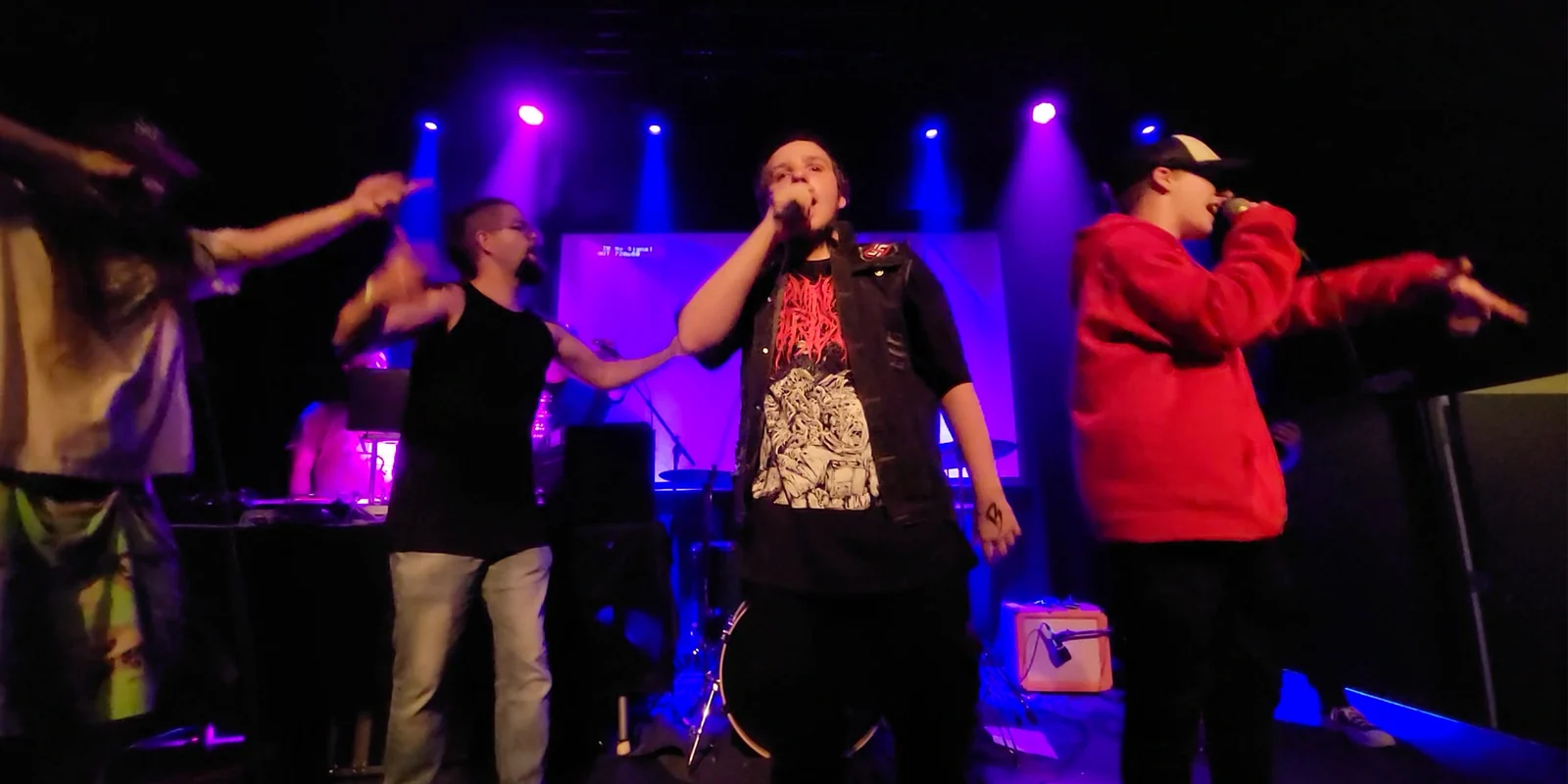
I don't fully have words for that night.
The crowd was packed. Keanu's screams were perfect - that raw punk energy right where it needed to be. The Cones had the room from the very first song. And when "Killing Field" hit at the end of the set and the whole roster came out on stage - everybody who built this thing, standing together in front of a room full of people who actually showed up for us - that's one of those moments you don't completely understand while you're inside it.
You just feel it moving through you and you hope you remember it right.
I felt it.
One More Thing About Mike
I mentioned we recorded Sanguine and Gold in Mike Morton's basement while he worked nights. Mike works at a rehab hospital. He would absolutely destroy me if I wrote that he saves lives, so I'm definitely not writing that.
What I will write is this: Mike makes these incredible drawings. The Sistine Chapel ceiling - with robots. The Last Supper - with robots. Cloaked and hooded fantasy figures - robots. Detailed, intricate, stunning pieces of work that he sits at his job and makes in his downtime. He has to have made twenty or thirty of them. And if you call them artwork, he will genuinely threaten to rip them up. He calls them doodles. They are absolutely not fucking doodles. He's started framing them and putting them up properly, which is the correct thing to do, and I love that he's coming around on it even if he'd never admit that's what's happening.
He's a gruff fella who doesn't show his emotions much. Two of the most important albums in KFR's history got recorded in his basement while he was off doing work he'd tell you not to make a big deal out of. The man doesn't take credit for anything.
I am genuinely, deeply proud of him.
And no, Mike, I didn't say you save lives. I said you make robots. Those are completely different sentences.
What Twenty Years Actually Looks Like
It's not a highlight reel. It's not a clean upward trajectory where every year is better than the last and every project lands bigger than the one before. It doesn't work like that and anybody who tells you it does is either lying or lucky.
It's downloading sounds off IRC one painful file at a time on early cable internet. It's a gas station parking lot in North Platte where some guy heard the bass and you sold him a CD out of your car. It's a closet with blankets on the walls and a kid eating spaghetti fifteen feet away. It's recording two albums of a deeply personal trilogy in a borrowed basement while your homie draws robots at a rehab hospital and tells everyone they're just doodles.
It's not listening closely enough in 2016 and spending years after that wishing you had.
It's going back to school because the music deserves better than what you can currently give it. It's mixing an entire album twice because you think spatial audio might be the future, then finding out the industry didn't agree. It's an all-nighter remaking instrumentals because a license got revoked and you refuse to pull a single song off streaming. It's building a website, rebuilding it, rebuilding it again because the standards keep rising and you won't let it be less than what it should be.
It's bulletproof vests retired on the walls of a studio in Turbine Flats where the neighbors are confused by the noise.
That's twenty years of this. That's what it looks like when nobody hands you a damn thing and you build it anyway - track by track, mistake by mistake, session after session in borrowed spaces and closets and basements - until one day you have a room of your own and a roster of people who trust you with the most important thing they've ever made.
The ten CDs are gone. The music is everywhere.
We're just getting started.
KFR